TDC PARSONS PEEBLES

Testing Capabilities

Testing Capabilities

TDC Parsons Peebles offers a range of AC and DC motor testing capabilities alongside our expertise in engineering capability, as well as the competencies within our dedicated workshop, ensures delivery of high performing machines to many applications worldwide.

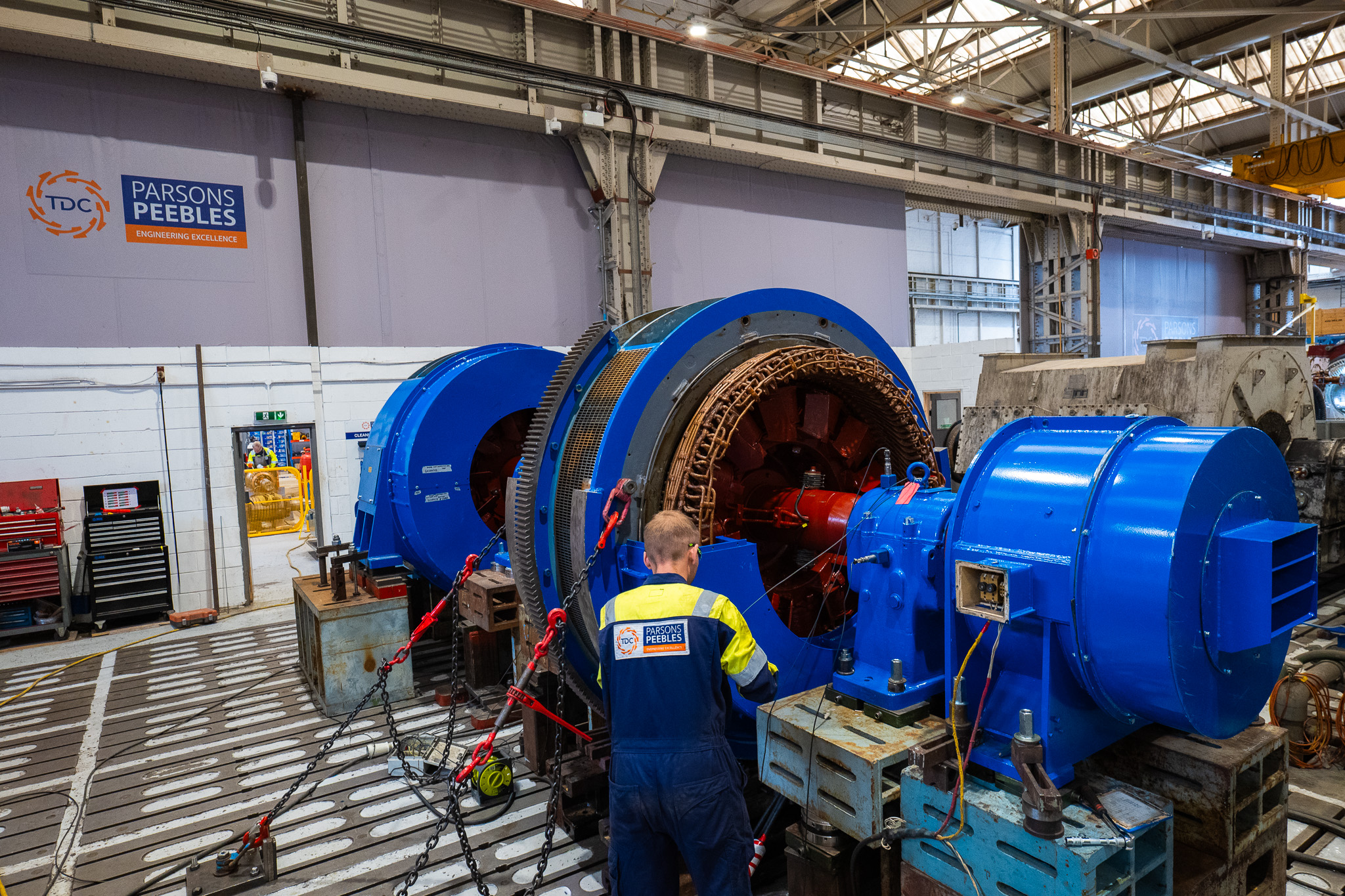
Our unique test facility in Rosyth, Scotland which has been specifically designed to handle high voltage motors and generators, allows us to conduct condition assessment and full load testing of repaired and new reverse engineered units, with direct load testing of induction motors up to 8MW @ 60Hz or 7.5MW @ 50Hz. Synchronous motors and generators up to 65MVA would be tested via the open circuit and zero power factor method. This service gives customer’s confidence in the performance of their machines before returning to or being newly installed at site.

We provide high voltage testing facilities for a range of machine models and makes. At TDC Parsons Peebles our aim is to provide services and products that are able to ensure the maintenance of high performance and life expectancy.

Engineering Excellence

Our Testing Facility

  • 8 MW incoming supply

  • 4 In-house Generators from 900kW – 40MVA

  • 4 available Test points in Test Plate Floor

  • 2000sq/ft of test plate floor

  • Service Pedestals to support single bearing machines

  • Independent cooling system

  • Independent lube oil supply system

Engineering Excellence

Our Testing Facility

  • 8 MW incoming supply

  • 4 In-house Generators from 900kW – 40MVA

  • 4 available Test points in Test Plate Floor

  • 2000sq/ft of test plate floor

  • Service Pedestals to support single bearing machines

  • Independent cooling system

  • Independent lube oil supply system

Engineering Excellence

No Load Testing

  • Where a Motor or Generator has had a minor overhaul and had not suffered a failure in service we would offer a No Load test to verify bearing temperatures and vibrations during a 2-4hr test in accordance with BS EN 60034-14:2018.

  • For a No-Load test run, the Motor or Generator is set to our test plate floor, shimmed and clamped  directly to our test plate. All No-Load testing is conducted at the rated voltage and frequency for the machine under test. Our test engineers monitor all parameter’s throughout the test, bearing & winding temperatures, voltage, current, frequency & speed. Another important part of a test run where the equipment has the ability to float is to measure and record the running magnetic centre while at full volts. We also continuously monitor the machine vibrations whether housing vibration or relative shaft displacement.

  • Following completion, our test engineer will compile and issue a test report. As always, during any performance testing our customers, third party condition monitoring or third party consultants are all welcome to review and sign off the machine prior to returning to site. 

Engineering Excellence

Direct Load Testing

  • Our facility is equipped to perform comprehensive load testing and thermal rise verification on motors ranging from 3.3kV up to 13.8kV.

  • Utilising our bespoke setup featuring an elevated foundation, epicyclic gearbox and induction generator, we offer testing capacities of up to 7.5MW at 50Hz and 8.0MW at 60Hz for 2, 4, 6, and 8 pole machines.

  • During these runs, we monitor critical parameters – including stator winding RTDs, bearing temperatures, and cooling flow rates until thermal stabilisation is achieved.

  • By calculating temperature rise via both resistance and RTDs along with analysing fractional load points during the test (100%, 75%, and 50%), we provide precise efficiency determinations and ensure every machine meets its exact performance and insulation class specifications.

Engineering Excellence

Back to Back Testing

  • Back-to-back load testing is a proven and efficient method used for heat run and performance testing of smaller induction motors using in-house test machines. In this arrangement, two motors are mechanically coupled together, with one operating as the drive motor and the other acting as a load.

  • By carefully controlling the electrical input, power is circulated between the two machines, allowing the motor under test to operate at full-load conditions while only losses are drawn from the supply.

  • This method closely replicates real operating stresses, enabling accurate assessment of thermal behaviour, efficiency and overall performance without the need for large external load equipment.

  • Back-to-back testing provides customers with a reliable, repeatable, and energy-efficient solution for validating smaller motors under controlled conditions.

Engineering Excellence

Synchronous Motor and Generator Testing

  • We can perform comprehensive synchronous motor and generator testing up to 65 MVA using a dedicated in-house test motor to mechanically drive the synchronous machine under controlled conditions.

  • This enables open-circuit and short-circuit testing to verify excitation, voltage and overall electrical performance. Temperature rise is proven using the zero-power factor (ZPF) test, where rated current is applied at near-zero power factor to replicate full thermal loading without mechanical output, accurately demonstrating overall thermal performance.

  • A two-part open-circuit heat run can also be performed to fully determine the temperature rise. RTD temperature measurements and vibration monitoring are carried out throughout each test to ensure thermal stability, mechanical integrity, and safe operation prior to return to service.

Engineering Excellence

Core Flux Testing

  • Stator laminations of an AC machine will invariably be short-circuited. Stator cores either by the barrel or core bars to which they are fitted; any additional inter lamination short circuits that might occur at the bore or slots of the core, could result in additional iron losses and localised overheating of the core.

  • A stator core flux test is a convenient means of confirming that in the region of stator bore and slots, the interlamination insulation is satisfactory, such that only normal or acceptable losses and heating will occur in service.

Engineering Excellence

CVF Testing

  • CVF is an advanced method used to perform induction motor heat runs without the need for an external mechanical load. By smoothly varying the supply frequency while the motor operates at no-load, the motor is made to alternately accelerate and decelerate. As the supply frequency is increased, the motor accelerates and absorbs additional electrical power; when the frequency is reduced, the motor slows down and returns stored energy back to the supply, briefly operating as a generator.

  • When these changes occur rapidly and in a controlled manner, the motor experiences an average electrical load equivalent to full-load operation.

  • This approach enables accurate thermal performance testing using a combination of the main rated supply and a lower-voltage auxiliary supply at a slightly different frequency, providing a reliable and efficient alternative to conventional mechanical loading methods.

  • The CVF in accordance with BS EN 60034-29:2008 (previously BS EN 61986:2002) called “Equivalent loading and superposition techniques – Indirect testing to determine temperature rise”.

  • While CVF testing is an alternative to a direct load test,  the total losses of an induction motor during a CVF heat run will always exceed that of a motor under direct load conditions.  This results in a greater temperature rise, approximately 10°C higher than if the motor was direct load tested.

Engineering Excellence

Purge System Testing

  • Beyond the standard rotating performance of machines, TDC PP also carries out the installation and commissioning of bespoke purge systems suitable for high-voltage machines. The installation process involves the precise mounting of purge units, pressure relief valves, and associated pipework, ensuring completion to the highest engineering standards. Managing the commissioning process directly provides a comprehensive solution that addresses the complexities of hazardous area integration and facilitates adherence to international and certification safety standards.

  • During the manufacture of new machines requiring certification, TDC PP proactively engages with recognised certification bodies, such as Baseefa, throughout the design validation and compliance process. This collaborative approach ensures that the pressurised enclosure system is subjected to full conformity assessment and functional verification in accordance with applicable standards.

  • Assembled purge and pressurisation systems are subjected to rigorous validation testing prior to final certification. This includes controlled gas displacement trials whereby the machine enclosure is charged with inert gases such as nitrogen or argon to simulate hazardous atmospheric conditions. Gas concentration levels are continuously monitored via strategically positioned sampling points (“sniffer” tubes) connected to calibrated gas detection instrumentation. These tests verify purge efficiency, confirm complete displacement of internal atmospheres and validate purge timing and pressure control parameters before formal purging sequences are approved.

  • This structured testing regime provides both TDC Parsons Peebles and the end customer with documented assurance that, upon each purge and pressurisation cycle in service, the enclosure atmosphere is effectively cleared of hazardous gases and maintained within certified safe limits.

PARTNER WITH US

Contact Us